Zoë’s Birth
The Art of Racing in the RainZoë’s Birth marks both the arrival of Denny and Eve’s daughter and the beginning of Enzo’s conscious role as her protector. The event unfolds at home while Denny is in Daytona for the Rolex 24 Hours, so family and racing occupy the same day from opposite ends of the country. Its meaning shifts with what Enzo learns afterward: what he initially imagines as Denny’s triumphant race is, in fact, a lost opportunity he never gets to take part in.
A birth on race day
Denny had spent the year seeking sponsors, and the money he eventually secured gave him a seat in a Porsche 993 Cup Car for the Rolex 24 Hours of Daytona. The endurance race required four drivers to take turns at the wheel, each facing a long stint in a powerful, demanding car. To Denny, the chance to drive was a hard-won opening; to Eve, its timing was troubling, because their child was due around the same period. The contrast was already present before labor began: the race represented an opportunity Denny had worked toward, while Eve faced the uncertainty of a birth that would not wait for a convenient date.
On race day, more than a week before the expected time, Eve began having contractions and called the midwives. They came to the house and took charge. That evening, Eve gave birth with their help, and the newborn was placed against her until she began nursing. The scene is intimate and immediate, but Denny is absent. Enzo, who narrates the event retrospectively, first assumes Denny must be driving and winning in Daytona. What he does not yet know is that Denny’s race has already been derailed before he can take a turn at the wheel.
Enzo is included
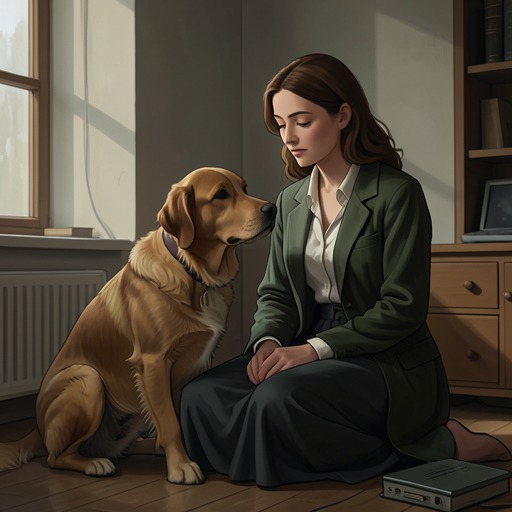
After the birth, Eve initially began to ask for a moment alone, and one midwife started to leave. When the other invited Enzo out of the room, Eve stopped them and allowed him to stay. Enzo understands this as an unexpected admission into Eve’s inner circle. He watches her with the baby, then notices that she is crying. Rather than presume that she wants him close, he waits until her hand moves and her eyes meet his; she then scratches his head while the baby continues nursing.
Eve asks Denny to promise that he will always protect their daughter. Enzo recognizes that the request is directed to Denny, not to him, but he experiences it as an obligation too. Since he cannot interact with people in the way he wants, he sees comfort and protection as forms of care he can offer: he can be there for Eve when Denny is away and guard the child. The birth therefore establishes more than a new family relationship. It gives Enzo a purpose within that family, one grounded in attentive presence rather than speech.
The race that Denny missed
The next day, Denny returns from Daytona unhappy. Holding his daughter changes his mood, and the parents name her Zoë, after Eve’s grandmother rather than after Enzo. Denny introduces the baby to Enzo with delight, while Enzo’s response reflects his conviction that he has already been part of her arrival. Their different perspectives make the newborn a point of connection: Denny meets his daughter for the first time, while Enzo feels that his promise of care has already begun.
The reason for Denny’s unhappiness emerges later. His team’s car had been running well and stood second in class; Denny was due to drive the third stint and might have taken the lead as night fell. During the second stint, however, another driver moved aside for a faster Daytona Prototype, struck loose tire rubber beside the racing line, and lost control. The car hit the wall and was taken away on a flatbed. The driver was unhurt, but the team’s race was over before Denny had driven a single lap. His suit, sponsor patches, specially fitted helmet, radio equipment, ventilation adaptors, and protective HANS device remained part of the unrealized opportunity he watched being hauled away.
Denny tells Mike that the money is not what matters to him; what he cannot accept is that he should have been home. He insists that, if he is any good, he should have known what would happen. The belief is not presented as fact—the crash and the early birth were events beyond his control—but as the standard he imposes on himself. The race-day coincidence thus becomes a sharper conflict: Denny has lost the chance he worked for and believes he should have chosen differently, while the daughter whose arrival coincided with that loss is also the person who makes his return home meaningful.
Zoë’s later voice
Later scenes show Zoë not merely as the infant whose arrival changed the family, but as a child able to express what she wants within decisions made by adults. When Eve wants Zoë to stay with her and her parents, Denny takes his daughter into the backyard after dinner to discuss the arrangement. He explains that he will visit daily, spend weekends with her, and sometimes have her stay with him. Zoë responds that her grandparents want her too. Her answer registers the competing attachments around her, even as Denny is visibly upset and tries to conceal it.
After Eve’s death, Zoë’s wish becomes more direct. She tells Denny she wants to come home and live with him and Enzo, but he explains that lawyers and judges will decide where she lives. Her insistence exposes the gap between a child’s clear preference and her limited power over the legal process. When Denny later says that someone has accused him of something very bad and that he must prove he did not do it, Zoë asks whether her grandparents were responsible. Denny says they were not the accusers, while acknowledging that they know about the accusation. Her question shows that she is actively trying to understand the forces shaping her life, rather than simply receiving adult explanations.
The birth’s significance therefore extends beyond the day itself. The infant whom Eve entrusts to Denny’s protection grows into a child who names where she wants to belong and questions the adults around her. Enzo’s first sense of duty—to remain near and protect her—acquires new weight as Zoë’s home and relationship with her father become matters of dispute. The event begins a family bond that will be tested, while its original contrast remains: the day Denny misses his first racing lap is also the day he becomes a father.